



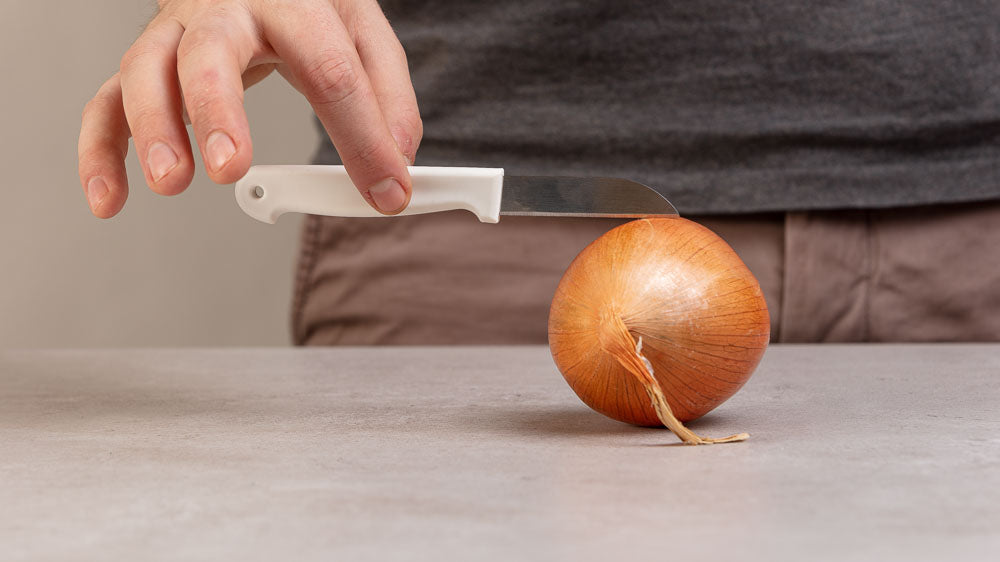
Or: how to murder a vegetable. Let's start with the basics of onion crushing. First, the knife. Not a sharp chef's knife. No. We mean the cheap plastic utility knife in the photo below. Edge or spine, it makes no difference.
Bonus points if the blade is shorter than the onion is wide. Now every cut takes two goes. Double the work, double the fun!
This excuse for a knife should have rattled around your kitchen drawer for at least five years. If not, drag it along a brick wall. Nice and blunt. We wouldn't want to cut ourselves. Or anything else.

Please don't try this at home
The cutting technique
Time is money. So let's find a way to put in lots of effort, take plenty of risk, and get very little usable onion out.
Hold the onion with your fingers stretched out. No claw grip, no safety first. Skip the smooth rocking cut. Stab the point in first, since that's the only sharp bit left. Then rock and crunch. Squeeze out as much juice as you can.
Crying is mandatory. It's meant to be hard. With pure willpower you should manage about one 'chopped' onion every 15 minutes. Cooking is fun.

If only there was a better way
Walk before you run
Done any of the above? Then we're glad you found us. Cutting an onion properly is the first step towards good knife skills, and towards cooking with more confidence.
Just picked up your first chef's knife? Go slow. Want to polish your skills? Go slower. That gives you two things:
Good habits from day one
Slow, controlled moves help you learn the right technique. Unlearning a bad habit is harder than learning a good one.
All ten fingers
No need to dice an onion in five seconds like Gordon Ramsay. He's had decades of practice.
You have years of cooking ahead of you to practise. That is enough time to get good at it. Start with these 11 basic chef's knife techniques.

About the tears
Why onions make you cry
When you cut an onion, you break open its cells. That releases a sulphur compound called syn-propanethial-S-oxide. It floats up into your eyes, and your eyes make tears to wash it away.
Good news: a sharp knife helps. It slices cells cleanly instead of crushing them, so less of the stuff gets out. A sharp knife is also quicker, so you spend less time crying. One more tip: leave the root end alone as long as you can.
Still a few tears? That's okay. We all cry sometimes.
A correction: an older version of this post blamed oxalic acid. That was wrong. It's the sulphur compound.
So, what is the right way?
Dice an onion in 3 steps
You didn't think we would leave you hanging, did you? Use a sharp knife and the claw grip from our guide to using a chef's knife.
1
Halve and slice
Cut the onion in half and lay one half flat on the board. Slice it lengthwise, starting at the root.
2
Turn and cut across
Turn the onion a quarter turn and make one or two horizontal cuts. Keep the fingers of your other hand well clear of the blade.
3
Chop
Now chop the onion into small pieces. You should end up with cubes of about the same size.
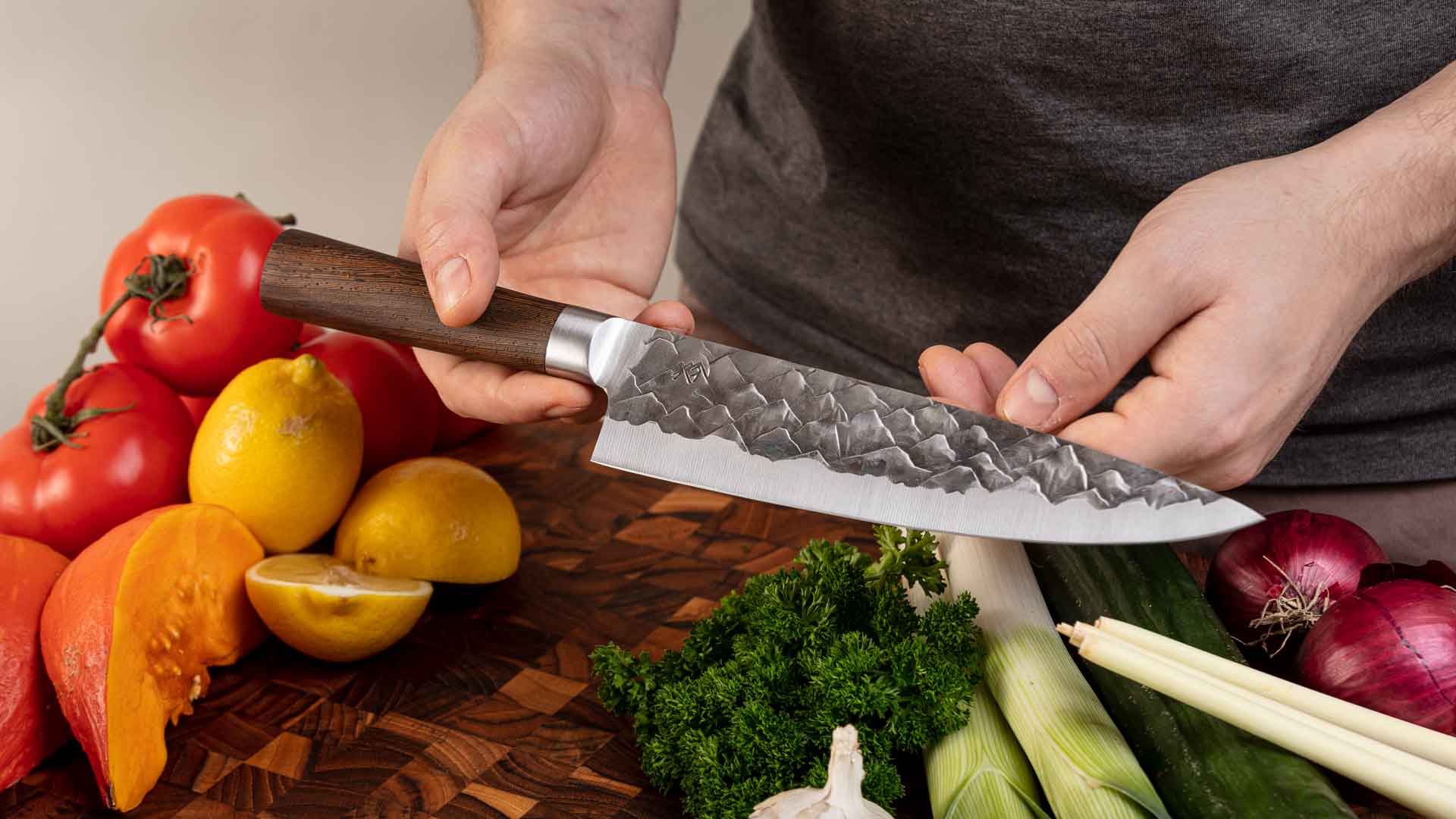
Need a sharper knife for the job?


Keep reading