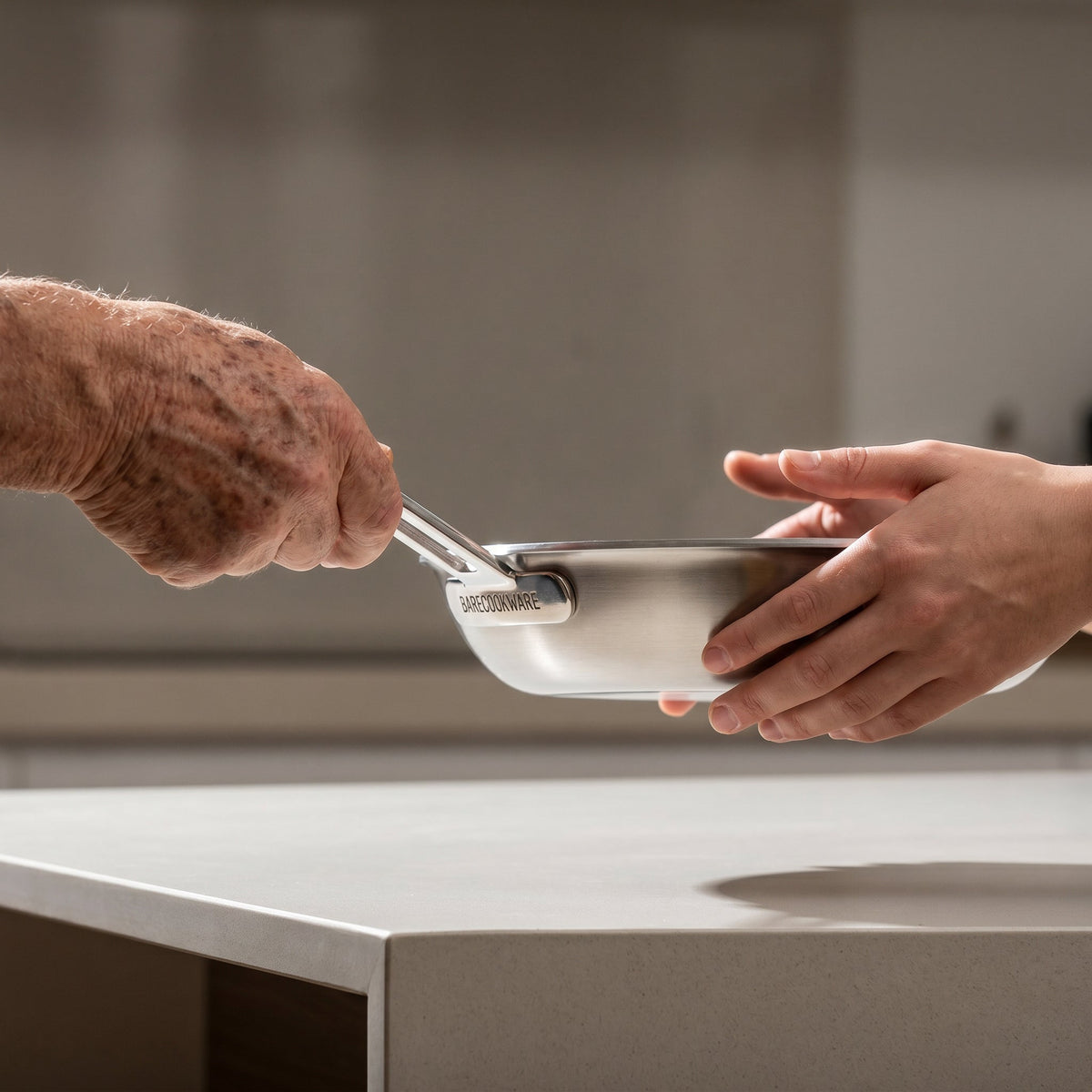




Everpan comes in 20, 24 and 28 cm. Which one you need depends on how many people you cook for, what you cook most, and the size of your hob. Here is a quick way to choose.
Good to know: the size is measured across the top rim. The flat part you cook on is smaller, because the sides slope outwards.
Quick answer
Which size for whom?


Why size matters
Too small or too big both cost you
Too small: food sits too close together. It lets out moisture and steams instead of browning. Your steak turns grey, your potatoes go soft. If you often cook in two batches, your pan is too small.
Too big: oil spreads into the empty parts of the pan and can burn there. A big pan also takes longer to heat and is heavier to lift and wash.
Rule of thumb: the food should cover most of the bottom, with a little space between pieces.
Check your hob
Match the pan to your burner
A pan heats evenly when its base roughly matches the burner or cooking zone. On induction, the pan should cover the zone. A 28 cm pan on a small zone heats mostly in the middle. A 20 cm pan on a large gas ring lets flames lick up the sides.
Everpan has a 3-ply body with an aluminium core, so heat spreads well across the base. It still helps to use the zone that fits.
Only buying one?
Our honest advice
Cooking for two or more
Take the 28 cm. It covers the most ground. The trade-off: it is the heaviest and needs a large zone.
Cooking mostly for yourself
Take the 24 cm. Big enough for a full meal, light enough for everyday use.
Short on space or a small hob
The 24 cm fits almost everywhere. The 20 cm works well as a second pan.
Or all three?
Why the set is our most popular choice
In real kitchens, sizes get used side by side: eggs in the small pan, vegetables in the middle one, meat in the big one. The set gives you all three sizes and costs less than buying them one by one.

Keep reading