



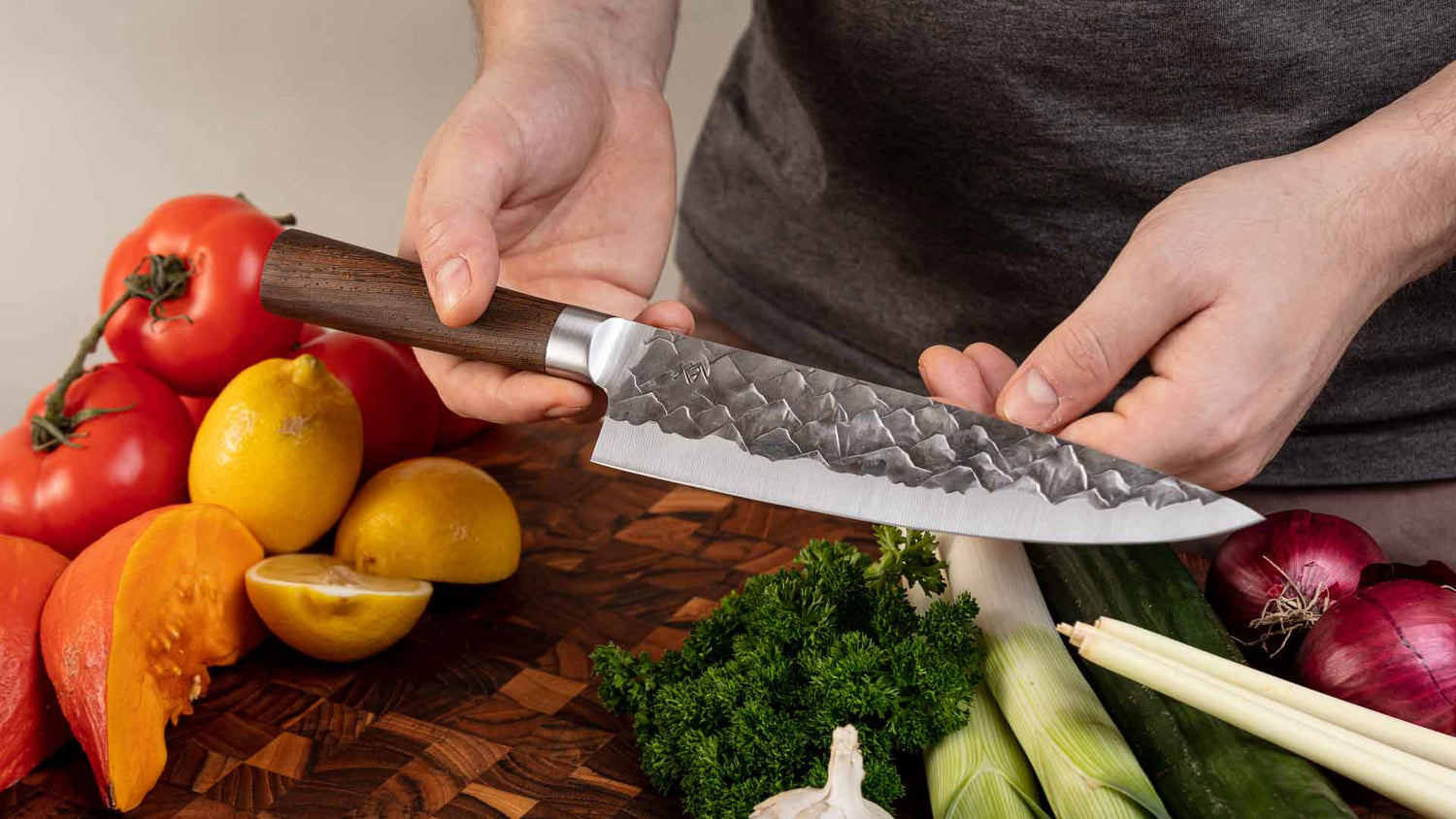
Never used a chef's knife before? It can look a bit scary. It is a lot bigger and sharper than the potato peeler you are used to. The good news: the basics are simple.
Here is how to hold the knife, how to keep your fingers safe, two cuts to start with, and how to look after your knife when you are done.
Your knife hand
How to hold a chef's knife
Holding just the handle feels natural, but it gives you little control. Use the pinch grip instead.
Pinch the blade between your thumb and the side of your index finger, just in front of the handle. Then wrap your other three fingers around the handle. That's it.

Feels odd? That is normal for the first few days. Your fingers sit close to the blade, so you steer the knife with more control.
Your other hand
The claw grip
Your other hand holds the food. Curl your fingertips under, like a claw, and hold the food with them. Let the flat of the blade rest against the middle part of your fingers.
Your fingertips stay tucked away from the edge, so you only cut the food.

Start cutting
Two basic cuts
The main rule: take it slow. Get the motion right first. Speed comes later on its own.
The rocking cut
Rest the tip of the blade on the board and the side of the blade against your claw hand. Move the knife forward and down, then back and up. Your hand makes a small circle. Move along the food as you go.
The chop
Keep the blade against your fingers as before, and move the knife straight up and down. Good for chopping herbs or small veg very fine.
Want to learn more cuts? Try these 11 things you can do with a chef's knife.
After cooking
Clean up and look after your knife
Hold the knife under the tap for a few seconds. If needed, wipe it with a soft sponge or cloth. Then dry it straight away. Store it on a magnet strip or in a knife block.
A few habits keep your knife sharp for longer:
- Hand wash only. The dishwasher dulls the edge and can cause rust spots. Got a spot anyway? No need to worry, it is easy to fix. See how to remove rust from a knife.
- Keep it out of the cutlery drawer. Other metal scratches the blade and dulls the edge.
- Cut on wood or plastic. Glass, stone or metal boards dull your knife much faster, and the knife slips more easily on them.
- Let the knife do the work. If you need to push hard, your knife needs sharpening. Force makes a knife slip, and that is how you cut yourself. A sharp knife is a safe knife.
- Scrape with the spine. Pushing food off the board with the edge dulls it. Turn the knife over and use the back of the blade.

Need somewhere to keep your knife, or a way to keep it sharp? These help:


Above all: stay safe. A good knife makes cooking more fun. Take your time and it stays that way.
Keep reading